
AMADOR COUNTY DEMOCRATS · EDUCATIONAL GUIDE
Understanding biomass power plants
How combustion and pyrolysis work, what they produce, and what evidence matters when evaluating a proposal.
At a glance
Biomass can supply energy through several processes. Combustion releases heat by burning it. Pyrolysis uses heat to break material down with little or no oxygen. Electricity requires a further conversion step. The process name alone does not establish efficiency, emissions or climate effects; those require feedstock, equipment and operating evidence. EPA technical background.
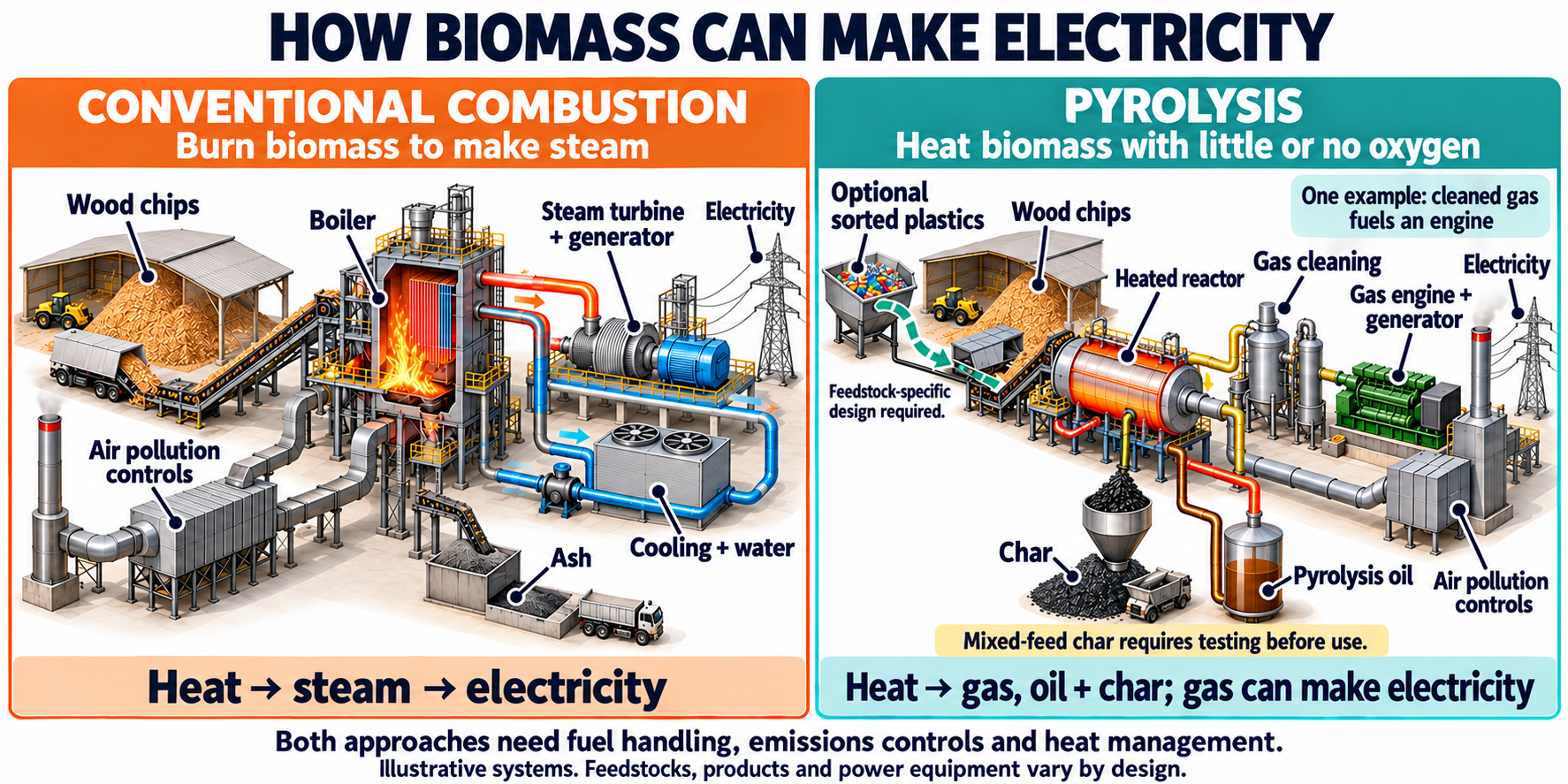
Illustrative systems; actual designs vary. Conventional combustion and one pyrolysis-to-electricity arrangement, including optional feedstock-specific co-pyrolysis. Select the diagram to view its large labels at full resolution.
Reading the illustration
The approved diagram compares selected configurations, rather than complete engineering designs. On the left, biomass combustion supplies heat for a boiler, steam turbine and generator. On the right, pyrolysis produces gas, condensable liquids and char; the illustrated electricity pathway uses cleaned gas in an engine-generator.
The optional sorted-plastic feed represents equipment designed for particular feedstocks. It does not mean ordinary biomass plants accept mixed plastic waste. Tires are deliberately excluded. “Pyrolysis oil” and “char” are descriptive labels, not certification that the liquid is a ready-to-use fuel or the mixed-feed char qualifies as agricultural biochar.
Conventional combustion: heat, steam and electricity
Fuel-handling equipment prepares and delivers biomass to the boiler. Combustion heats water into steam, which drives a turbine connected to a generator. The installation also needs systems for managing heat, flue gas and ash. Fuel characteristics and equipment configuration influence performance. Source: EPA biomass CHP catalog.
A proposal should identify its boiler, fuel specification, pollution controls, cooling arrangement and ash destination—not simply describe the plant as “biomass powered.”
Pyrolysis—and how gasification differs
Pyrolysis thermally decomposes feedstock without the oxygen supply used for ordinary combustion. It produces varying quantities of gas, condensable vapors collected as liquids, and solid char. Temperature, heating rate, residence time, feedstock and reactor design affect the products. A process optimized for liquids should not be assumed to deliver maximum char and electricity simultaneously. Source: peer-reviewed review of pyrolysis technologies and product yields.
Pyrolysis requires heat. Some systems use their own products to supply it, reducing the amount available for sale or another use. Gas or char used to heat the reactor cannot also be counted as an exported product. Source: experimental study of residual-biomass pyrolysis.
In the illustrated arrangement, cleaned gas fuels an engine-generator. Whether a particular installation can reliably do this, and its resulting net electrical output, require a complete process design and operating evidence.
Pyrolysis is not interchangeable with gasification. Gasification uses reactions involving a controlled gasifying medium, such as oxygen, air or steam, to convert material toward combustible gas. Pyrolysis can occur within gasification, but the overall processes and product objectives differ. Source: scientific review of biomass conversion pathways.
What goes in?
Feedstock preparation can include receiving, sorting, size reduction and drying. Moisture and material characteristics matter to handling and conversion. Source: EPA biomass preparation background.
Request sources, material types and quantities, with wet and dry weights distinguished; moisture ranges and contaminant acceptance limits; tests representing the proposed feedstock; storage capacity and dust/fire-management arrangements; and delivery routes, payloads, operating days and truck movements.
Truck estimates should distinguish deliveries from total vehicle movements and include outgoing ash, char, liquids and other materials.
Electricity output: gross is not net
Gross generation is electricity produced by the generator. Net output accounts for electricity consumed by the plant itself. Fuel handling, pumps, fans and other equipment reduce electricity available for export. Source: EPA power-production and performance background.
Ask separately about purchased electricity and fuel for startup, drying or reactor heat. Distinguish electricity from useful heat delivered to a real customer.
Illustrative calculation: a plant generating 10 MW while consuming 2 MW internally has 8 MW remaining at that boundary. This is arithmetic, not a claim about an actual plant. A rated capacity in MW does not establish annual generation in MWh; that requires operating hours and output during those hours.
Emissions, water and residual products
Air controls have specific jobs. A fabric filter, or baghouse, captures particles from a gas stream. Its presence alone does not establish control of every gaseous pollutant. Request pollutant-specific limits, control descriptions and test results. Source: EPA explanation of fabric filters.
Examine the whole installation: fuel handling, process heating, electricity generation, startup and shutdown, and any flares or bypasses. Gas cleaning before an engine and treatment of engine exhaust address different points in the system.
Water figures need a boundary. Thermoelectric plants can use water for steam generation and cooling. Withdrawal describes water taken from a source; consumption concerns water not returned, including evaporative losses. A circulating-water loop alone does not establish freshwater requirements. Source: USGS thermoelectric-water background.
Request annual and peak-day water balances, sources, discharge destinations and wastewater-treatment requirements.
Residuals need testing and a destination. Ask what happens to ash, char, collected dust, condensates and rejected feedstock. For a soil product, request feedstock eligibility, representative laboratory results and applicable requirements. Biochar certification frameworks have feedstock and product-quality criteria; they do not establish that unspecified mixed-feed char is suitable for agriculture. Source: European Biochar Certificate guidelines.
Carbon accounting: follow the material and the alternatives
Biomass should not be assumed automatically carbon-neutral. Climate effects depend on feedstock origin, land and vegetation carbon, supply-chain emissions, conversion efficiency and displaced energy or products. The alternative matters: what would happen to the material and land without the project? Source: IPCC assessment, Chapter 7.
A project assessment should state its timeframe and account for collection, preparation, transport, supplementary fuels and product destinations.
Char production alone is not proof of permanent carbon removal. Establish how much carbon remains, its expected persistence, eventual use and production emissions. Carbon burned later as fuel has a different fate from carbon retained in a durable application. Source: European Biochar Certificate carbon-sink accounting background.
Plastic-derived carbon must be identified separately rather than treated as newly grown biomass carbon.
What the pinewood-and-plastic experiment establishes
A laboratory fixed-bed study examined pinewood and high-density polyethylene (HDPE). Increasing HDPE increased liquid yield under the tested conditions. At certain mixtures, measured oil yield or product-composition outcomes exceeded calculated weighted-average expectations.
That is the relevant meaning of synergy here: an outcome exceeding the authors’ baseline, not a general finding of environmental superiority. The experiment does not establish lower commercial-plant emissions, higher net electrical efficiency, reliable mixed-waste processing or commercial viability. Source: original peer-reviewed study, DOI 10.1093/ijlct/ctad103.
How to read the evidence
A laboratory experiment demonstrates results under its experimental conditions. An engineering model predicts outcomes from assumptions. A vendor statement describes the supplier’s claims. Independently measured commercial performance documents what an installation achieved during a defined test or operating period. These forms of evidence answer different questions.
Unresolved evidence: this guide has not established matched commercial operating data for the compared systems and feedstocks, a local plant’s current design or capacity, mixed-feed product eligibility, or site-specific water use, emissions, traffic and operating history. No commercial efficiency or emissions advantage is asserted.
Local-project scope: current dated process documents, equipment scope, capacity definitions, feedstock quantities and operating status are needed before describing Buena Vista/NYGC. Earlier capacity and feedstock scenarios have not been reconciled and are excluded.
References and further reading
Sources appear beside the claims they support. EPA’s biomass CHP catalog dates to 2007; it is used for process background, not current costs or market status. Peer-reviewed reviews, laboratory experiments, government assessments and certification frameworks are identified in the text.
NITI Aayog, Enhancing Circular Economy of Waste Tyres in India (January 2026) documents tire-pyrolysis systems and environmental concerns, including polluted process water. It is further reading for a separate tire discussion, not evidence of biomass-plant performance. Tire pyrolysis is not the same as open tire burning.
Evidence review: October 20, 2026. Unavailable information is labeled unknown; unsupported project claims remain unconfirmed.
Questions to ask about a proposed facility
1. What exactly will it process? Which materials, quantities, moisture ranges and contaminants were tested?
2. Which process is actually proposed? Combustion, pyrolysis, gasification or a combination? What supplies its heat?
3. Where is the complete mass and energy balance? Does it account for every product, waste stream, internal fuel use and purchased energy?
4. What electricity reaches the customer or grid? Is the advertised figure gross or net, rated or measured? What annual generation and availability records support it?
5. What has been measured commercially? At what scale, for how long, with which feedstock and under whose testing?
6. What leaves the site? Request emissions tests, water and wastewater balances, residual testing and documented product destinations.
7. What supports the carbon claim? Ask for the baseline, timeframe, land-carbon assumptions, plastic-carbon accounting and char fate.
8. What happens outside normal operation? Examine startup, shutdown, failure, rejected feedstock and product-market failure.
9. What remains unknown? Request permits, monitoring arrangements, unresolved assumptions and a schedule for missing evidence.